
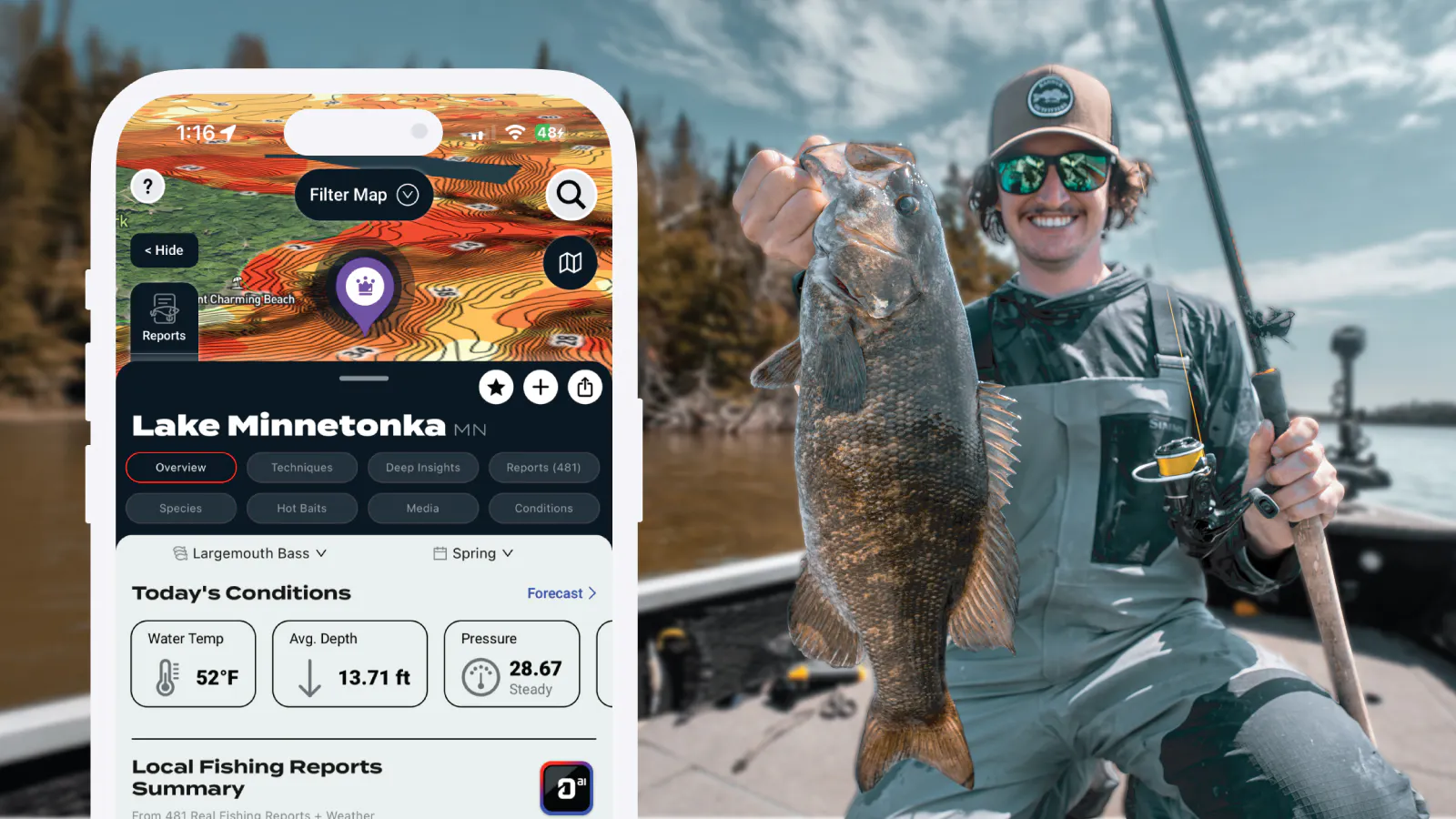
How to Build a Game Plan on Omnia in 4 Easy Steps
Look, we get it. Omnia has gotten big. Lake pages, fishing reports, hotbaits, map layers, contour lines, water clarity, water temp, wind, weather, bottom hardness, vegetation, Navionics charts, waypoints. If you're a new angler poking around for the first time, it can feel a little like opening up a tackle box at a garage sale: a lot of good stuff in there, but where do you start?
So we did some user testing. We watched real anglers click around the site, and a pattern jumped out. The folks who walked away with an actual game plan all did roughly the same three or four things in roughly the same order. So we're just going to come out and say it: here is the order you should be doing things in.
This is how you turn "I'm fishing Minnetonka on Saturday" into "I'm fishing the north end of Carson's Bay first, then sliding out to the rockpile off the point, throwing a jig and a drop shot."
TLDR:
• Step 1: Deeeeep Insights - Start with the fishing report summaries provided in the Lake Page Deep Insights Tab. Click on a lake pin and then on a deep insights tab for that lake.
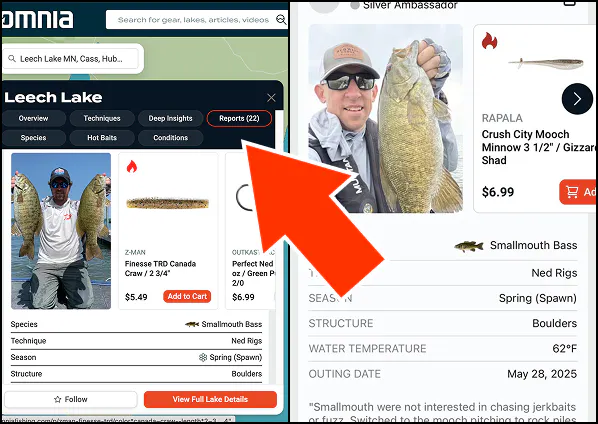
• Step 2: Browse free fishing reports and hotbaits from those tabs on your lake.
• Step 3: Engage maps to orient yourself for a plan.
• Step 4: Everything else - Wind forecast, major and minor best times to fish, water temp, public land, etc.
Let's dive in on each step!
Step 1: Start with Deep Insights (Fishing Report Summaries)
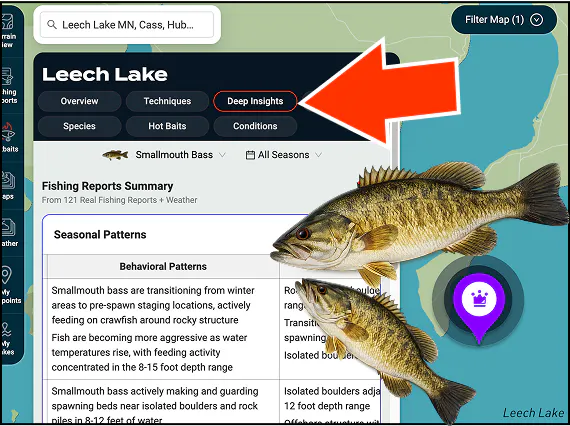
Every lake page on Omnia has a Deep Insights tab. This is where you start. Not the map. Not the shop. Not the rabbit hole of YouTube videos about Lake Minnetonka. The Deep Insights tab.
Why? Because fish don't care what's trending on TikTok. Fish care about water temperature, season, forage, and where they can find both food and cover at the same time. Deep Insights is the tab that tells you what the fish are probably doing right now on this specific lake, given the time of year and the species you're after.
Think of it as the "what's going on out there" briefing. Are the bass pre-spawn and pushing shallow? Are the walleyes still deep on the breaks? Is it primetime for crappies suspending over basins? Deep Insights gives you that read before you commit to a single bait or a single spot.
The takeaway from Step 1: A working theory about fish behavior on your lake, on the day you're going.
If you want to see it in action, here's the Deep Insights tab for Lake Minnetonka. Go poke around. We'll wait.
Step 2: Check the Fishing Reports and Hotbaits
Okay, you have a theory. Now you need ground truth.
This is where the Fishing Reports and Hotbaits sections come in. Fishing Reports are filed by real anglers fishing your lake, often within the last few days. They'll tell you what's working, where they caught fish, what depth, what cover, and what they were throwing. Hotbaits is the aggregated version of that, basically: "here are the lures actually catching fish on this lake right now."
This is your sanity check. If Deep Insights says "bass should be transitioning to deep weed edges" and the most recent fishing reports are all about pitching jigs to deep weed edges with a Strike King Rage Bug, congratulations. Your theory just got confirmed by other anglers' wet boats. Build your plan around that.
If the reports are saying something different than what Deep Insights suggested, that's even more useful. Maybe a cold front blew through. Or maybe you think one angler is a better insight than another. Maybe the fish are doing something weird. Either way, you know now, and you can adjust. That's the whole point.
The takeaway from Step 2: A short list of techniques and baits that are actually working, backed by real reports. Throw those in your boat bag.
Step 3: Layer in the Map (PRO Subscribers, This One's For You)
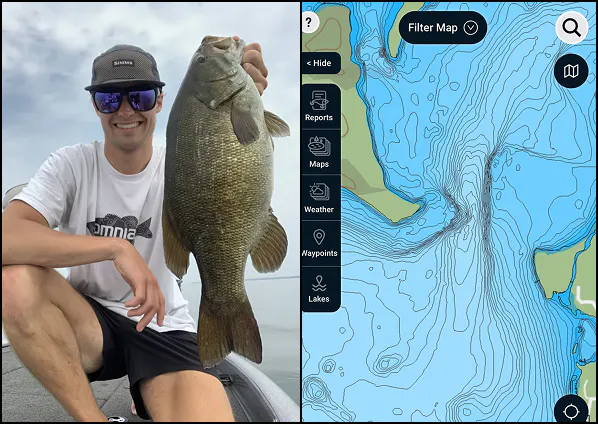
Now you've got a theory about fish behavior (Step 1) and confirmation about what's working (Step 2). The last piece of the puzzle is where on the lake to go.
This is where the PRO map layers earn their keep.
The map layers aren't really there for browsing. They're there to help you orient yourself to everything you just learned in Steps 1 and 2. Big difference.
A few examples to show you what we mean:
• Deep Insights said the bass are warming up and pushing shallow. So you flip on Water Temperature and look for the bays warming the fastest. Now you know which end of the lake to launch on.
• A fishing report mentioned "fishing the deep weed edge in 12 feet." So you turn on C-MAP Contours and C-MAP Vegetation and trace those edges across the whole lake. Now you have 15 spots that match the pattern, not just the one in the report.
• Hotbaits says crayfish-imitating jigs are crushing. So you turn on C-MAP Bottom Hardness to find the rock-to-soft transitions where crayfish actually live. Now your plan has places, not just baits.
• The wind is blowing 12 mph out of the southwest. So you check the Weather layer and figure out which shorelines will have bait pushed in, and which ones you should skip until the wind shifts.
See what's happening here? The map layers aren't a step on their own. They're the step that turns insight into spots. Without Steps 1 and 2, the map is just a really pretty map. With Steps 1 and 2, the map becomes a treasure hunt where you already know what's buried.
The takeaway from Step 3: Actual GPS-able locations on your lake that match the pattern you've already identified. Drop some waypoints. You're done planning.
Step 4: Sharpen the Plan with Everything Else
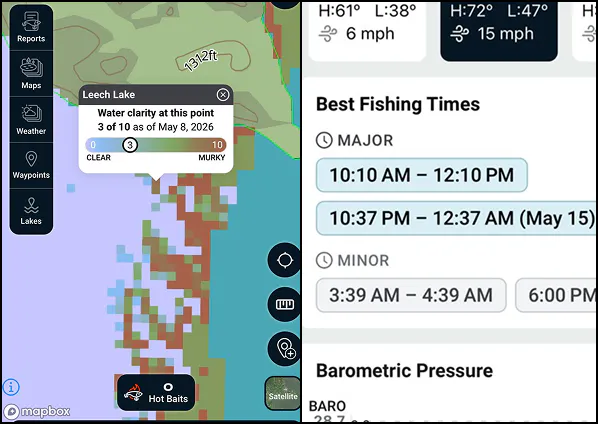
Steps 1 through 3 will get you a real game plan. Steps 1 through 3 plus Step 4 will get you a really, really good one.
Once you know what, how, and where, Omnia has a whole stack of supporting data that helps you fine-tune the rest of the trip. None of it is the main course. All of it can be the thing that turns a decent day into a great one. A few of the big ones:
• Solunar and best times to fish. Major and minor feeding periods, sunrise, sunset, moon phase. If you've only got a few hours on the water, line those hours up with the windows when the fish are most likely to chew. Easy edge.
• Barometric pressure trends. Falling pressure ahead of a front tends to fire fish up. Stable high pressure after a front tends to lock them down. Knowing which side of the curve you're on changes how aggressively you fish.
• Water level data and dam offsets. On reservoirs and river systems, water level is the whole ballgame. Rising water pushes fish shallow into flooded cover. Falling water pulls them out to the first break. Omnia surfaces water level stations and dam release data so you're not guessing.
• Tide stations. If you're fishing coastal or tidal water, you already know the tide is the boss. Omnia shows you the stations near your spot so you can plan your launch around the right tide window.
• Public Lands and Boat Landings. This is the unsexy but critical layer. Where can you actually launch? Where can you legally walk in and bank fish? Public Lands shows you the shorelines you can access without trespassing, and Boat Landings shows you every official ramp on the lake.
• Public Fish Attractors. Many state DNRs sink cribs, brush piles, and structure to concentrate fish. Omnia maps the publicly reported ones. Free spots. Use them.
• Lightning strike and storm radar. This one's just safety. Check it before you launch and check it again when the sky starts looking funky.
You don't need to use every one of these on every trip. The move is to glance at them, grab whatever's relevant to your day, and ignore the rest. Going to a tidal river? Tide station is non-negotiable, water clarity is whatever. Fishing a reservoir after a week of heavy rain? Water level is the first thing you check. Fishing your home lake with three hours after work? Just check solunar and go.
The takeaway from Step 4: The little stuff that turns a plan into the right plan for the day you actually have.
How It All Comes Together
Use Deep Insights to figure out what the fish are doing. Use Fishing Reports and Hotbaits to figure out how to catch them. Use the PRO map layers to figure out where to go do it. Then use everything else to figure out when, how to get there, and what to watch out for.
That's it. That's the plan. If you're new, or if you've been Omnia-curious and haven't quite known where to start, do this in this order and you'll have a real game plan for your next trip in about 15 minutes.
And if you're not a PRO subscriber yet, you can run Steps 1 and 2 right now for free on any lake in the country. When you're ready for Step 3, the 7-day free trial is sitting right there.
Now get off the website and go fishing.